
Michael Schauch contemplates the existential koan: “Who am I?”

Michael Schauch was eight when he looked into a mirror and asked a question that has occupied philosophers for centuries: Who am I?
“I remember looking into the mirror, into my own eye. And it’s like, who is that?” he recalls. “I don’t know why at that age I was already asking those questions. But the questions were already there.”
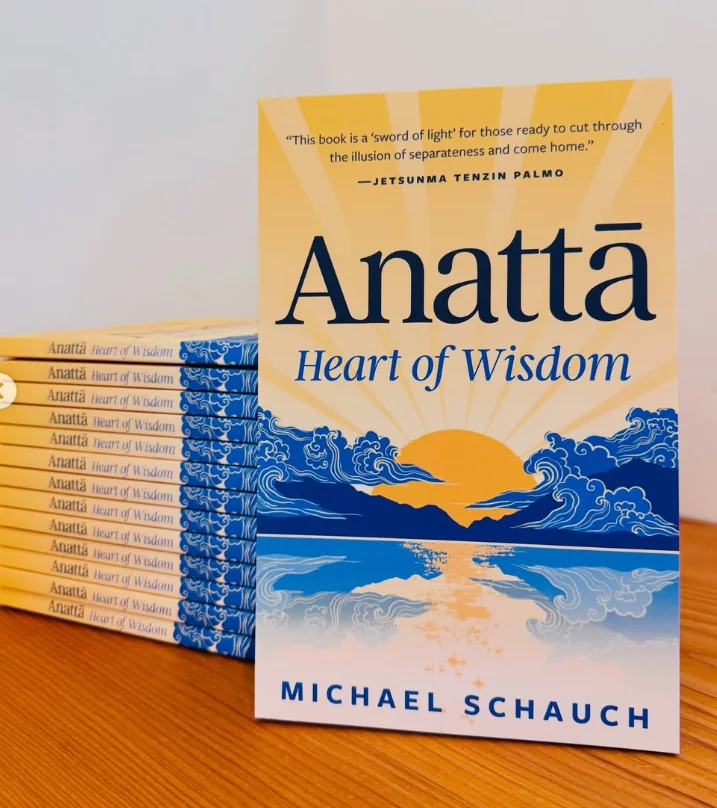
That inquiry, into what the mirror reflected and what it could not reveal, has followed Schauch into the mountains, taken him to Nepal, and helped shape a family that spans continents. It sits at the core of his latest book, Anattā: Heart of Wisdom.
In a sense, the book has been taking shape since that first encounter with his reflection. The questions have deepened over the years, finding expression in his reading, his relationships and his experience of the natural world.
How mountaineering and Zen Buddhism shaped Michael Schauch
Michael Schauch grew up in Brentwood Bay on Vancouver Island, in a family that nurtured a love of nature. A hiking trip to Carmanah Valley is still etched in his memory. At about sixteen, an older friend took him on his first mountaineering trip.
“This is the first time I was sort of climbing. And I remember we were going up a steep snow slope. And it was very terrifying, but also very exciting,” he says. “And I remember stopping and looking behind me, and the sunrise was just coming. And then on the horizon were all kinds of other mountains. And the sky was like pink, purple, and I had this feeling that this is where I belong.”
Mountaineering felt like his own. Over time, the mountains became places where he could examine the impulses that brought him there: the desire to test his body, reach a summit and prove something to himself.
“It was like a mirror,” he says, “like wisdom coming from the mountain.”
Alongside the climbing, an interest in Buddhism was taking root. At about fifteen, browsing in a bookstore, he picked up a small book of Zen stories. He still owns it. Its ideas felt immediately familiar.
“And immediately, I thought this makes sense,” he recalls.
How a failed climb in Nepal led to A Story of Karma
Eventually, his love of mountains took him to Nepal. In 2012, at age 32, he travelled there to climb a peak he had been drawn to for some time, called Chako. Things began coming apart almost at once. He was caught in a snowstorm at 5,000 metres, and the mule carrying his climbing gear ran away.
“The mountain said no,” he says. Stuck and unable to climb, he was forced to sit and ask himself why he was there. “I don’t know why I’m here. But I just have to trust in where the series of events wants me to go.”
That trust led him and his wife, Chantal, to a village called Nar, where a seven-year-old girl taught a class of children English numbers. “We uncovered a karmic connection,” he says. “That’s the only way I can describe it.”
The girl was Karma. He and Chantal would become part of her life and that of her younger sister, Pemba, parenting alongside the girls’ own parents and helping them pursue an education. Schauch calls the chain of events behind it “crazy” synchronicities, and he tells the story in his first book, A Story of Karma.
What is anattā? The Buddhist teaching of non-self
Part memoir, part contemplative reflection, and interspersed with poetry and essays, Anattā follows Schauch’s own spiritual inquiry.
He wants readers to know they do not have to be Buddhist to read it. He does not identify as a Buddhist himself, wary of adopting yet another label through which to define the self.
“I mean, the Buddha wasn’t Buddhist,” he says.
Anattā, he explains, means “non-self.” The teaching challenges our belief in a permanent, unchanging, independent self. The identities through which we understand ourselves, including our gender, race, social class and personal histories, cannot capture the whole of who we are.

For Schauch, the teaching speaks directly to familiar sources of dissatisfaction: anger, fear, anxiety, the expectations we carry, and the persistent feeling that we are not good enough.
“Where do these dissatisfactions come from?” he asks. “These dissatisfactions come from a belief that we are an independent self. But nothing is an independent self.”
“Everything is interconnected. And I would say everything is actually interbeing. Everything is interexisting. We cannot exist by ourselves. We cannot exist without everything else around. I can’t exist without the air, without the sun, without the soil for the food and all the rest of it. So we’re all existing, always together.”
Our sense of who we are is fluid, he says, and the suffering begins when we try to hold it still. “When we try to hang on, that’s where the suffering happens.”
The solid self we call “me,” with its identity and its stories, is only part of reality, he emphasizes. “It comes across as the final reality truth, but it is only part of it. It’s like looking at a river. The water is always going. But if we say, no, that water is the river, it’s like, no. It’s part of the river.”
How to practise non-self: noticing and loving-kindness
Understanding this intellectually, he says, is only a beginning. Through practice, it can become something we embody. And practice begins with awareness.
“The starting point is just by being aware, by noticing,” he says.
We can notice the thoughts and feelings arising within us, the stories we tell ourselves and what our senses take in. Through that attention, he suggests, we begin to see how much of what we call the self consists of shifting experiences and ideas.
“The more we notice them, the more we can start to see that there is no independent self,” he says. “That these are all ideas, parts, different things that are constantly changing.”
He adds that no one can reach non-self through sheer effort. “It’s being, not practice.” The first step is to notice without reacting, “not chasing it like a dog chasing a stick.” Beyond that, he points to qualities the Buddha called innate: loving-kindness, compassion, joy in others’ well-being, and equanimity.
Kindness comes easily toward family and is harder toward strangers, but he says that is the point. Even when it feels superficial, “you keep doing it, and one day it turns a bit more sincere.” Practised this way, he says, “you will feel at home wherever you go.”
Intuition and the non-self: a lesson from Sky Pilot
Asked about a time when his practice failed him, Schauch does not hesitate. It was a climb of Sky Pilot about a decade ago.
The night before, he had a strong feeling that he should not go. He went anyway, because his two friends said it was a beautiful day. On the glacier, the feeling grew so strong that he told them to go ahead without him. They asked what he saw, and he could not name any danger. “I felt it, like, deep, but I couldn’t voice it.” He agreed to go a little way and reassess.
Near the top, where the slope was steep and icy, two other climbers who had followed them slipped and fell about 200 metres. Schauch and his friends went down and called 911. One of the climbers died.
“I overrode intuition,” he says. The experience made him wonder how many times each of us does the same, every day, in smaller ways. “Intuition could also be the non-self speaking through you.”
What Michael Schauch hopes readers take from his books
Asked for the biggest surprise of the past fifteen years, he returns to intuition. “Deeply listening, and acting on that, can open the most profound experiences and connections, in ways we could never plan.” It is what led him to Karma, he says, and he could never have arranged it.
Asked what a reader might take from his two books and everything behind them, he gives a short answer.
“It would just be to loosen our grip a little bit,” he says. “On everything. On our ideas of who we should be, on our ideas of who we are, on all the stories we hold, on what we think is right, what we think is wrong. Just loosen our grip a little bit.”



Comments
Note: Sea to Sky Healer welcomes your opinions and comments. We do not allow personal attacks, offensive language or unsubstantiated allegations. We reserve the right to edit comments for length, style, legality and taste.